Light and colour

The first image is a photo of hikers in the Indian Himalayas.
In this image you can see the snow reflecting light from the sun closer to the sun, and further away it begins to appear less reflective and have much more soft lighting. The colour of the sky is reflected much more strongly in the shadow of the hikers and because of the relative brightness of their dark side and the sky they appear to be silhouettes. The fog in the distant hill range reduces the intensity of the light and darkness that would be apparent if closer. They darkest parts of those hills aren't nearly as dark as the sillhouettes of the hikers and the brightest parts of the fog are just about as bright as the snow to the side of the image not reflecting the suns' bright light at us.
There is very little colour to speak of aside from that of the sky being reflected from the snow. The yellowish orangey tinge on the horizon is not rich in colour, I think this might be the case because this is shot from so high up. Maybe the fact we're above it and seeing the reflected light as opposed to being beneath the fog/clouds where the light would have been scattered through the fog and we wouldn't be able to see the direct sun light. The refracted light would have had to travel further and because we know colours are richer in the shade it's not entirely false for me to assume that those colours would be richer beneath the clouds.
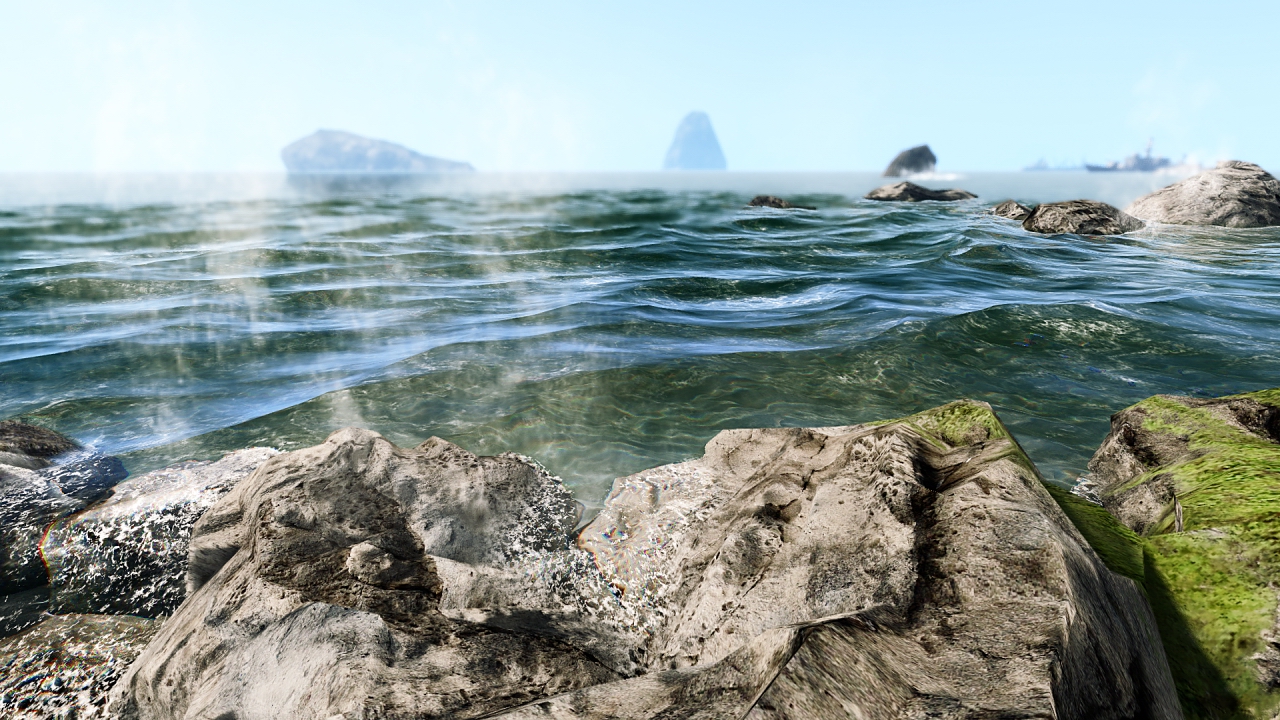
This image is a screenshot from Crysis.
I think the user who took this had custom shaders or ENB mods or was simply using a custom config.
The water is refracted at the edge of the rocks creating the rainbow effect. The water is clearest the closer you are to it and reflects more light from the sky the further away you look (Fresnel effect). The blue hint on the distant objects indicates they are far away because of particulates in the atmosphere which absorb the weakest light frequencies. The weakest frequencies are reds and yellows leaving blues, the longest waves to still be visible. The intensity of the light from those distant objects is much lower as a result of the light having to pass through the atmosphere. The brightest pats of this image are the highlights on the rocks and white froth of the sea. both of which are right next to the viewer. The darkest shadows too are the closest becoming more and more washed out the further from the viewer the shadows are.
The brown of the rock is much richer in the darker, shaded areas of the rock, the same goes for the mossy green to the right of the image.
Underneath the surface of the water there is a caustic effect on the sand.

This painting by George Grie shows sub-surface scattering in the clouds as they do not fully reflect or absorb the light of the moon.
The water fall is lit by bounce-light which is why it has no harch shadows, nor do the huge statues holding the crust of the earth up. The boat however does have a harsh shadow as it is in direct light from the moon.
Notes from the lecture
light can be - Absorbed , reflected , refracted
you can see absorption when objects appear to be a certain colour or black. they absorb all the colours they're not reflecting.
reflected light is simply light that bounces of the object. the light that because of the objects properties is able to proceed in it's course as opposed to being entirely nullified.
refraction is when light is bent, this happens through water or glass or other transparent substances. the substance has a particular make up that channels the light in a specific fashion.
this very property is utilised in 3d glasses you wear to the cinema
frensel effect - how reflective a substance is based on viewer position
water is transparent from above with very little reflection
from next to the surface looking along it you can see reflections much more clearly and see through the water much less.
sub-surface scattering
when an object doesn't fully absorb or reflect light it will pass through it
you can see this effect by shining a torch through your finger tips or your ear using a mirror. the light appears very soft and will glow with intensity relative to the thinness of the substance.
